
Obsolete Electronic Components: Sourcing Guide
Obsolete electronic components refer to devices that have been officially discontinued by the original manufacturer, are in the process of being discontinued, or are no longer recommended for use in new designs. They are typically associated with unstable supply, extended lead times, price fluctuations, and the pressure to validate alternative parts.
Let's start with the component lifecycle stages.
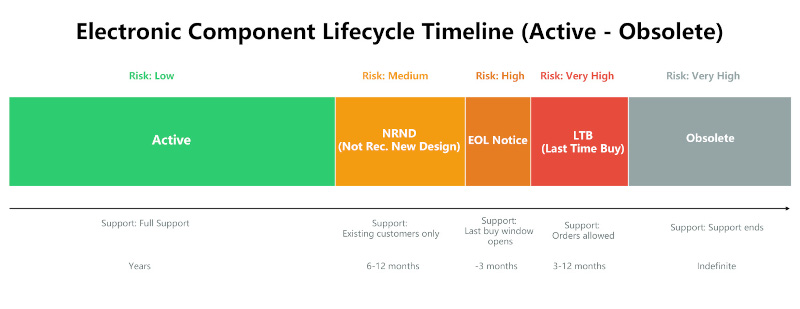
From their introduction to their withdrawal from the market, components go through several key stages. Understanding these stages is the foundation for managing component obsolescence.
• Active (in mass production): The original manufacturer is producing the component normally, supports new designs, and supply is stable.
• NRND (Not Recommended for New Designs): Still available for purchase, but not recommended for use in new projects.
• EOL (End-of-Life): The manufacturer has issued an official discontinuation notice, typically providing a final purchase window.
• LTB (Last Time Buy): A critical milestone in the EOL process, allowing for the placement of the final batch of orders.
• Discontinued / Obsolete : The original manufacturer has ceased production, and the product is no longer available through regular channels.
Obsolete does not always mean unavailable. Remaining stock from authorized distributors, third-party refurbished parts, or verified alternative models may still be available on the market. However, the manufacturer's mass production support, long-term supply assurance, and design recommendations have ended.
Why does a component become obsolete?
Discontinuation is rarely accidental; it is typically the result of multiple overlapping factors.
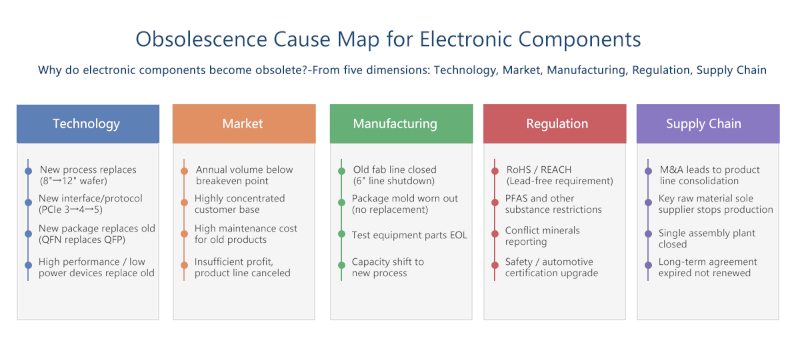
• Technology upgrades and wafer process migration : As process platforms, production capacity layouts, and product roadmaps evolve, devices based on older process nodes or specific wafer platforms may no longer receive ongoing investment from the original manufacturer, leading them to enter NRND, EOL, or Obsolete status sooner.
• Declining market demand : When annual demand for a certain type of component falls below the manufacturer's break-even point, maintaining production lines is no longer economically viable.
• Discontinuation of raw materials or packaging formats : Lead-containing terminations and certain plastic encapsulation materials may be phased out because of environmental requirements or supply constraints. Molds for certain legacy packaging formats (such as DIP and PLCC) are no longer repaired once they become obsolete.
• Regulatory restrictions : Regulations and compliance requirements such as RoHS and REACH drive restrictions on hazardous substances, lead-free manufacturing, and material declarations. Traditional components containing lead or restricted substances may require redesign, recertification, or discontinuation.
• Supplier mergers and acquisitions and production line closures : Following an acquisition, product lines may be consolidated or eliminated entirely (e.g., ON Semiconductor's adjustment of its product portfolio after acquiring Fairchild).
• Aging production equipment and discontinued spare parts : Production equipment itself requires electronic components. When equipment suppliers cease support, production lines cannot be repaired and must be shut down.
For example: An 8-bit MCU used in an automotive ECU designed in 2005 faced the closure of its foundry's 6-inch wafer line in 2020. After evaluation, the original manufacturer determined there was insufficient customer volume to justify migrating production to a newer wafer line, so the manufacturer issued an end-of-life (EOL) notice, requiring customers to complete their final purchase within six months.
Actual Impact on OEMs, EMS Providers, and Repair Teams
Once a component becomes obsolete, it affects the entire manufacturing and repair chain: risk of production interruptions, BOM review, requalification, and possible recertification, capital tied up in inventory, and pressure to secure spare parts for repairs. For ODMs/OEMs, the risk of component discontinuation is no longer an issue that the procurement department can resolve alone; rather, it is a cross-functional engineering and supply chain challenge that must be considered during the product lifecycle design phase.
From "Individual Part Numbers" to "Product Lifecycle Management"
Many engineers are accustomed to focusing solely on the part numbers used in their current projects, only becoming concerned when they receive an EOL notice from the original manufacturer years after mass production has begun. A more reasonable approach is to integrate component lifecycle awareness with product lifecycle management:
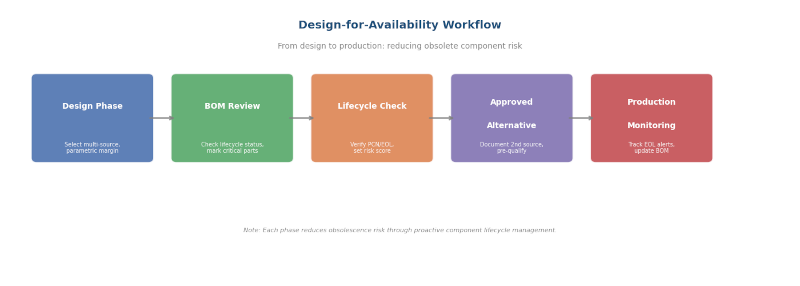
1. Design and Selection Phase: Prioritize components with multiple sources of supply (secondary sources), mainstream packaging technologies, and clear manufacturer roadmaps. Avoid using non-mainstream, customized, or supply-chain-unstable packaging versions, and Avoid selecting models explicitly marked as "Not Recommended for New Designs" or "NRND".
2. Mass Production and Maintenance Phase: Regularly scan the BOM to identify components that have entered NRND or EOL status. Plan for replacement testing 6--12 months in advance.
3. LTB Decision: Calculate the optimal final purchase quantity based on the product's remaining sales lifespan, annual failure rate, and inventory holding costs.
4. Replacement Path: Prioritize pin-to-pin replacements from the original manufacturer → remaining inventory from authorized distributors → third-party independent sources (requiring strict verification) → redesign and board modification.
● What Are Obsolete Electronic Components and How Do They Differ from EOL and NRND Parts?
Obsolete electronic components refer to components that the original manufacturer has officially ceased production of, no longer provides long-term supply assurance for, and generally no longer recommends for use in new designs. Two concepts that are often confused with this are EOL(End of Life) and NRND (Not Recommended for New Designs). Simply put: NRND means the manufacturer does not recommend using the component in new designs, but existing projects may still be able to continue procuring it; EOL means the manufacturer has issued a clear discontinuation schedule and final purchase window; Obsolete typically means that after the EOL process is complete, the manufacturer no longer produces or provides standard supply, and procurement relies primarily on remaining inventory, compliant channels, or alternative parts.
A Quick Comparison of Active, NRND, EOL, Discontinued/Obsolete, and LTB
| StatusManufacturer SupportAvailabilityEngineering and Procurement Recommendations | |||
| Active | In regular production, supports new designs | Stable; available within standard lead times | Available for use; check product change notices periodically. |
| NRND (Not Recommended for New Designs) | No longer recommended for new projects, but existing orders will still be fulfilled | Available for purchase in the short term, but may enter EOL at any time in the future | Switch immediately for new designs; evaluate alternatives for existing BOMs as soon as possible; do not rely on this product long-term |
| EOL Notice (End-of-Life Notice) | Official notice issued by the manufacturer, including last order date and last ship date | Orders can still be placed before the deadline, but lead times may be extended | Immediately initiate LTB calculations to determine the final purchase quantity |
| LTB (Last-Time Buy) | A specific window during the EOL process that allows for a single order covering all future demand | Orders are accepted only during this window; no orders will be accepted thereafter | Precisely calculate inventory levels based on the product's remaining lifespan and maintenance requirements to avoid excessive stockpiling |
| Discontinued / Obsolete | Original manufacturer production and standard supply have been completely discontinued | Unavailable through regular channels; relies on authorized distributor inventory, the secondary market, or alternative parts | Can only be addressed through remaining stock, refurbished parts, or redesigns; exercise caution when using unauthorized channels |
EOL and Obsolete are not the same thing
When a manufacturer decides to discontinue a device, it first issues an EOL notice (End-of-Life notice). This document specifies the last order date, last shipment date, and recommended replacement part numbers. Upon receiving an EOL notice, companies typically have a 6- to 12-month window to execute a "last-time buy"---that is, to purchase in a single transaction the quantity required for the coming years or even the remainder of the product's lifecycle. Once the last ship date has passed, the device officially enters the "Discontinued" or "Obsolete" status. At that point, the manufacturer will no longer accept any orders or provide production support.
So the difference is this: EOL is a process (from notification to discontinuation), while obsolete is the endpoint.
Why can't you just look at an e-commerce inventory page to determine the status?
Many engineers first search for inventory on Mouser, Digi-Key, or other e-commerce/stock platforms, but "in stock" does not necessarily mean the part is still in the "Active" status with the original manufacturer. The true basis for determining a component's lifecycle must be PCNs (Product Change Notices), PDNs (Product Discontinuance Notices), or EOL notices issued directly by the original manufacturer. These documents are published on the manufacturer's official website or through authorized distributor systems, clearly indicating the date of the status change and the last opportunity to purchase.
A common pitfall: A part may be labeled "Active" on an e-commerce page, but the manufacturer has internally classified it as NRND (Not Recommended for New Designs) without publicly updating the distribution system. By the time you go into mass production and suddenly face a supply disruption, you may check the EOL notice only to find that the window has already closed.
Practical Engineering Recommendations
If a part is marked as NRND, immediately develop a phase-out plan; upon receiving an EOL notice, initiate an evaluation on the same day; if a part is marked as Obsolete, first check authorized distributors and specialized EOL suppliers such as Rochester Electronics (such as Rochester Electronics), then consider alternatives or board redesign.
● Why Do Electronic Components Become Obsolete?
Electronic components become obsolete, discontinued, or phased out, typically driven by a combination of declining commercial viability and technological advancements: the former includes declining sales, rising maintenance costs, and insufficient profits, while the latter includes new processes, new interfaces, new packaging, or higher-performance devices replacing older models. Specifically, technological upgrades, shrinking market demand, the phasing out of wafer processes or packaging formats, stricter environmental regulations, upstream material supply disruptions, supplier mergers and acquisitions, and aging production line equipment can all push a component toward the end of its lifecycle.
The following analysis breaks down these factors by category and outlines the impact on users as well as proactive prevention strategies.
| Cause CategoriesTypical Triggering FactorsImpact on UsersPreventive Actions | |||
| Technical Causes | New manufacturing processes (e.g., 8-inch → 12-inch wafers), new interfaces (PCIe 3 → 4 → 5), new packaging (QFP → BGA → LGA), and the emergence of higher-performance or lower-power alternative components | Legacy devices lose their cost advantage; original manufacturers cease development or even shut down production lines; users are forced to upgrade their design solutions | Prioritize mainstream processes, interfaces, and package types supported by multiple manufacturers during design selection |
| Commercial Reasons | Annual sales fall below the break-even point; engineering teams maintaining legacy product lines are laid off; customer base becomes highly concentrated (e.g., only one defense contractor remains) | Original manufacturers no longer actively maintain production; once inventory is depleted, the product enters EOL; users may face supply disruption without warning | Regularly assess the annual usage of each component in the BOM; plan early for replacements for components with low usage |
| Manufacturing Reasons | Foundries shut down outdated production lines (e.g., 6-inch lines); packaging molds are no longer repaired after wear and tear; testing equipment cannot be repaired due to discontinued parts | The original manufacturer is forced to cease production and cannot resume even if demand remains | Monitor information regarding the original manufacturer's wafer fabs and packaging/testing facilities, and select components with longer production line lifecycles |
| Regulatory Reasons | RoHS (Restriction of Hazardous Substances), REACH (Registration, Evaluation, Authorization, and Restriction of Chemicals), PFAS (Per- and Polyfluoroalkyl Substances) restrictions, conflict minerals reporting requirements, and new safety or automotive certification requirements | Older lead-containing components and plastic encapsulants containing specific flame retardants are banned from certain markets; original manufacturers are unwilling to recertify obsolete components | New designs should prioritize RoHS/REACH-compliant products and avoid using materials that will soon be restricted |
| Supply chain reasons | Product line consolidation following an OEM acquisition (e.g., ON Semiconductor discontinuing overlapping models after acquiring Fairchild); discontinuation of production by the sole supplier of critical raw materials (e.g., specific die types, lead frames) | Components that were previously in regular supply may suddenly be declared end-of-life (EOL) with no direct pin-to-pin replacement | Establish backup plans or stockpile single-source components in advance |
| Design-related reasons | Highly customized (ASICs/ASSPs designed for a single product), obsolete parallel interfaces (e.g., ISA, VME), or use of non-standard packages or voltages | No secondary source can be found, leaving the project in a dire situation once the original manufacturer ceases production | Unless absolutely necessary, avoid using custom chips in long-life products; if their use is unavoidable, sign a long-term supply agreement |
From a product lifecycle perspective, obsolescence is an inevitable outcome
No manufacturer will produce the same device indefinitely. As the user, the key is to identify the risk before a PDN arrives.
Which components are most likely to become obsolete?
Single-source components; devices using legacy or low-demand packaging; interface chips tied to outdated protocols; and custom automotive- or industrial-grade components.
Preventive measures: Conduct lifecycle checks early in the design phase, prioritize multi-source components, and prepare alternative component plans in advance.
Once you understand why components become obsolete, the next step is to learn how to systematically identify these high-risk components in the BOM and how to assess the overall BOM's risk of discontinuation.
How to Identify Obsolete Electronic Components and BOM Risk
The first step in identifying obsolete electronic components is to verify the lifecycle status published by the original manufacturer, PCN/EOL documents, and availability information from authorized channels. For individual part numbers, verify the MPN, manufacturer, package version, date code range, and data sheet revision status; at the BOM level, systematically flag high-volume, single-source, long-lead-time, or critical-function components, and assign an obsolescence risk score. The core principle is that no third-party spot inventory page should be used as a basis for determining "safety"; it is essential to trace back to the inventory source, ensure traceability, and verify the manufacturer's authorization status.
The following sections outline the process from individual component identification to BOM-level risk assessment.
Individual Part Number Identification: From MPN to Lifecycle Status
Once you have a part number, do not rush to search e-commerce platforms to see "if it's in stock." First, check the following indicators one by one:
| Identification IndicatorsVerify SourceRisk LevelNext Steps | |||
| "NRND" or "Obsolete" listed on the original manufacturer's official website | Manufacturer's product page, PCN database | High / Critical | Immediately seek alternatives and assess LTB requirements |
| No status indicated, but the last update of the datasheet was more than 5 years ago | Manufacturer's official website datasheet | Medium | Email the manufacturer or authorized distributor to confirm if the product is active |
| Packaged as DIP, PLCC, or legacy/low-demand TQFP variants | Package manufacturer discontinuation notice | Medium | Check for QFN or BGA alternative versions |
| PCN issued within the last two years, especially for wafer-fab or packaging/test-facility changes | PCN documents, authorized distributor notices | Medium → High | PCNs are often a precursor to EOL; set up monthly monitoring |
| Authorized distributors show "Out of stock, lead time > 52 weeks" | Digi-Key, Mouser, Arrow | High | Request LTB from the original manufacturer or seek alternatives |
| Only independent third-party stockists have inventory; authorized channels have none | Independent distributor databases | Critical | Thoroughly review traceability reports and consider a redesign |
One critical step: Perform a lifecycle check. Don't rely solely on e-commerce labels; instead, go directly to the original manufacturer's "Product Lifecycle" or "PCN/EOL" page. Many manufacturers provide public lookup tools (e.g., TI's Product Lifecycle, ADI's PCN Lookup). After entering the MPN, you will see a clear status: Active, NRND, EOL, Discontinued, or Obsolete. If the status is EOL, the document will include the last order date and last ship date.
Official information sources (in descending order of authority): Manufacturer's official website → Authorized distributors → Component lifecycle databases (IHS, SiliconExpert, etc.) → Subscriptions to manufacturer EOL notification emails → Engineer forums.
BOM-Level Risk Identification: Assigning an Obsolescence Risk Score to Each Component
For a complete BOM, it is impractical to devote the same level of effort to every single component. Priority should be given to those components whose unavailability would lead to the discontinuation of the entire product. We recommend using the following simplified obsolescence risk score model to assign a score to each line in the BOM, then address them in descending order of score.
| Risk FactorsScoring CriteriaPoints | ||
| Original Manufacturer Lifecycle Status | Active=0, NRND=3, EOL Notice=6, Discontinued/Obsolete=10 | 0--10 |
| Single / Multiple Sources | Multiple sources (≥2 compatible) = 0, Single source = 5 | 0--5 |
| Has a PCN been issued in the last 3 years? | No PCN = 0, Process/Package Change PCN = 3, End-of-Life Indication PCN = 5 | 0--5 |
| Authorized Channel Inventory | Adequate = 0, Short-term shortage = 2, Long-term out of stock (>26 weeks) = 5 | 0--5 |
| Criticality in the BOM | Easily replaceable = 0, Unique function with no substitute = 5, Critical function + long qualification cycle = 8 | 0--8 |
| Annual Usage | >10k = 0, 1k--10k = 2, < 1k = 5 | 0--5 |
Calculate total score: Maximum 38 points. Recommended classification:
• 0--6 points: Low risk — Routine monitoring is sufficient.
• 7--15 points: Medium risk — plan to evaluate alternatives within six months.
• 16--25 points: High risk — immediately initiate alternative testing or LTB calculations.
• 26 points and above: Critical — The production line is at risk of supply disruption; immediate redesign or a one-time purchase to cover all remaining lifespan requirements is required.
This scoring is not a one-time task. It should be rerun quarterly or semi-annually, as manufacturer lifecycle status, inventory levels, and PCNs are subject to change.
Six-step BOM risk management process: Export BOM → Batch lifecycle check → Supply risk aggregation → Calculate risk score → Generate action list → Periodic review (at least every six months).
The impact of discontinued parts goes far beyond simply "unavailability": uncontrollable lead times, skyrocketing prices, increased MOQs, counterfeit risks, and high engineering validation costs.
The most important reminder: Don't be fooled by "stock on hand".
Best practice: When authorized channels confirm stock is unavailable, if considering independent spot suppliers, you must require traceability reports, third-party test reports, and quality assurance agreements.
Even with traceability and testing documentation, materials from independent sources should be reserved primarily for non-critical repairs or short-term validation. For critical components in mass production---such as main chips, power management ICs, and interface protection devices---priority should be given to evaluating authorized end-of-line stock, validated alternatives, or redesigns; high-risk spot market purchases should not be used as a standard mass production solution.
● How Can You Confirm Whether an Electronic Component Is Obsolete or Near EOL?
The most reliable way to confirm whether a component is obsolete or nearing EOL is to verify the lifecycle status published by the original manufacturer, search for PCN/PDN/EOL notifications, check the order status with authorized distributors, review the latest datasheet for any "Not Recommended for New Designs" notation, and confirm that the currently available part number aligns with long-term supply information. This process should not be based on intuition, nor should you rely solely on a stock website showing "in stock." Below, we break down the specific steps into six parts.
Step 1: Verify the complete manufacturer part number
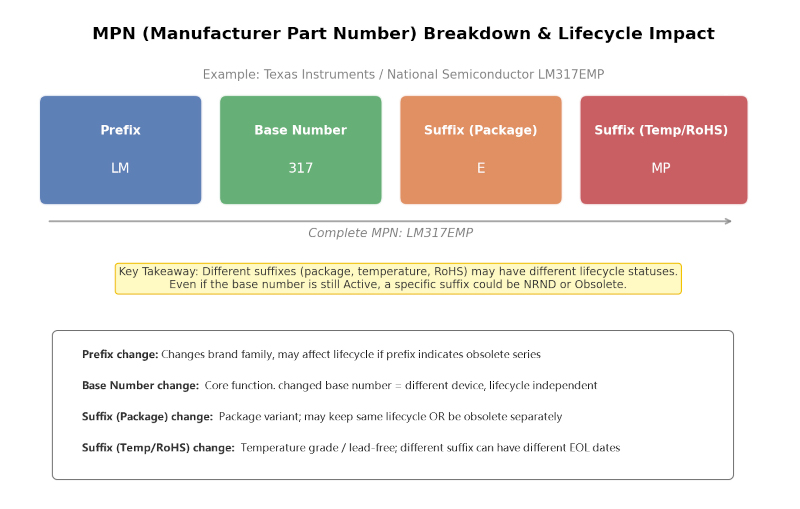
Many people get the status wrong because they use an incomplete part number. A complete manufacturer part number (MPN) typically includes:
Base model (e.g., LM317)
Package (e.g., SOIC-8)
Temperature rating (e.g., 0--70 °C, -40--125 °C)
Packaging (reel, tube, tray)
Electrical specifications (e.g., voltage accuracy, current range)
Lead-free / RoHS compliant
Common Mistake: You checked the general LM317 page, which shows "Active," but you are actually using the LM317AEMPX (a specific package and packaging variant). The manufacturer may have discontinued that specific suffix, but the base model is still in production. Therefore, you must always search using the complete MPN.
Red Flag: Searching the full MPN on the manufacturer's website returns 0 results, or only the datasheet is found without ordering information → Strong suspicion of discontinuation.
Step 2: Check the "Lifecycle Status" on the manufacturer's product page
Go to the manufacturer's official website (e.g., TI, ADI, Infineon, Microchip, ST) and search for the product page using the full MPN. Look for the "lifecycle status" field on the page. Common descriptions and their meanings:
| Status LabelMeaningNext Steps | ||
| Active / Production | In normal production | Routine monitoring, reviewed every six months |
| NRND (Not Recommended for New Design) | Not recommended for new designs | Evaluate replacements for existing products; prohibit use in new designs |
| EOL / End of Life / Last Time Buy | End-of-life notice issued | Record the last order date and last ship date immediately |
| Discontinued / Obsolete / End of Life | Discontinued; no longer accepting orders | Search for stock or redesign |
| Limited Release / Not for Resale | Engineering samples or custom parts | Contact the manufacturer to confirm availability |
Note: Some manufacturers do not explicitly label products as "Obsolete" on their websites; instead, they remove the page or redirect to a replacement model. If the MPN you search for automatically redirects to another model with a message stating, "This is an older model; we recommend using XXX"---this is a strong indication that the product is obsolete.
Step 3: Search for PCN, PDN, and EOL notices, and record key dates
Search by MPN in the "PCN / EOL" or "Product Change Notification" section on the manufacturer's official website. Alternatively, use a search engine to look for: "[MPN]" + "PCN", "[MPN]" + "EOL", or "[MPN]" + "Product Discontinuance".
Once you find the notice, pay close attention to:
Last Order Date: The final date on which orders can be placed. After this date, the manufacturer will no longer accept new orders.
Last Ship Date: The final date for shipment. The manufacturer will no longer ship products after this date.
Recommended Replacement: The manufacturer's recommended replacement part (sometimes pin-to-pin, sometimes requiring a PCB redesign).
Red Flag: Even if the Last Order Date has not yet arrived, once the notice is published, the part has already entered the EOL process. Do not wait until the week before the Last Order Date to place an order---by then, production capacity may already be fully allocated.
Step 4: Verify availability and lead times with authorized distributors
Go to an authorized distributor (such as Mouser, Digi-Key, Arrow, Avnet, or Farnell) and search for the full MPN. Note: Be sure to verify that the channel page clearly displays the word "Authorized," or that you know in advance that the distributor is listed on the manufacturer's official website as authorized.
Check the following information:
Stock status: In stock / Backorder / Not available
Standard lead time: Typically 4--20 weeks. If it shows 52 weeks or more, or is left blank → be cautious.
Does it display "End of Life" or "Last Time Buy"? Some authorized distributors will label this directly in the product listing.
Are there recommended replacement models? Authorized distributors often add a note at the top of the page after the manufacturer announces EOL, stating "This product is EOL, see replacement XXXX."
Common Misconception: If all authorized distributors show "Out of stock, no lead time," but a third-party website lists "10k in stock"---this does not mean the manufacturer is still producing the item; it only indicates that someone is selling old inventory or refurbished units.
Step 5: Check for hidden clues in the datasheet
Download the latest datasheet (from the manufacturer's official website; do not use outdated versions cached on third-party sites). Look for the following phrases on the first page, in the header or footer, or in the "Ordering Information" section near the end of the document:
Not Recommended for New Designs (NRND)
Discontinued
Obsolete
This device is no longer in production
Refer to [Replacement Part Number] for new designs
Some manufacturers do not explicitly label a part as "Obsolete"; instead, they remove the entire row for that MPN from the "Ordering Information" table, leaving only the replacement part numbers. If you find that the ordering information table in the current datasheet no longer includes your MPN, but it is present in older versions of the datasheet---this indicates that the part has been discontinued.
Step 6: Record the status and risks in your internal ERP/PLM system
After completing the above five steps, enter the findings into your internal system (ERP, PLM, or BOM management tool). We recommend using a standardized classification:
| StatusDefinitionInternal Action Code | ||
| Active | Confirmed by the original manufacturer as in normal production; authorized distributors may place orders; delivery times are normal | Green: Routine Monitoring |
| At Risk | Manufacturer has not issued an EOL notice, but there are warning signs: lead time extended by >30 weeks, PCN involving process changes, or the sole wafer fab is about to close | Yellow: Quarterly review |
| NRND | Manufacturer explicitly states that new designs are not recommended | Orange: Develop a replacement plan within 12 months |
| EOL | The manufacturer has issued an EOL notice; the last order date has not passed | Red: Immediately calculate LTB quantities and place an order |
| Obsolete | Last ship date has passed, or manufacturer status is Discontinued | Black: Stop regular procurement; resolve only through remaining inventory or redesign |
| Unknown | No clear information available from the above sources | Gray: Contact the manufacturer or an authorized distributor's customer service |
For EOL and Obsolete components, also note the following in the record: annual usage, current inventory, remaining production demand years, and verified replacement part numbers.
● How Do Obsolete Parts Affect Lead Time, Cost, and Production Planning?
When an electronic component becomes obsolete, the most immediate impacts are: standard lead times become completely unreliable, procurement prices skyrocket, minimum order quantities (MOQs) multiply, and supply sources shrink dramatically. At the same time, the risk of counterfeit products, engineering validation costs, and the likelihood of production line downtime all increase simultaneously. On the surface, you may simply be switching procurement channels, but in reality, the entire supply-chain cadence and cost structure change. Below, we explore this issue from five dimensions: lead time, price, quality risk, engineering investment, and production planning.
Lead Time: From a Few Weeks to an Uncertain Timeline.
During the Active phase, the standard lead time provided by the original manufacturer is typically 4--20 weeks, stable and predictable. Once a component becomes obsolete, this rule no longer applies:
The original manufacturer no longer accepts new orders: If the last order date has passed, you simply cannot place an order with the original manufacturer. You must instead source parts from remaining stock at authorized distributors, independent spot market suppliers, or the refurbished channel.
Delivery times in the spot market are extremely unstable: stock available today may be sold out tomorrow. Even if a supplier has inventory, you must factor in time for testing, refurbishment, and logistics---ranging from a few days to several months.
Response time for emergency procurement: When you discover a missing, discontinued component on the production line, your only option is usually to pay a premium and have a broker source it globally. From inquiry and testing to delivery, the process can take anywhere from one week to one month. This unpredictable lead time is enough to bring an entire production line to a standstill.
Action Plan: For obsolete components, stop using the concept of a "standard lead time." Instead, calculate "sourcing cycle + testing cycle + logistics cycle," and allow at least a 2--4 week buffer.
Cost: The purchase price is just the tip of the iceberg
Many people assume that obsolete parts simply mean "higher unit prices." In reality, the true cost is far greater than that. The following cost iceberg model breaks it down:
| Impact AreasChanges OccurringHidden CostsControl Actions | |||
| Unit Price | The original manufacturer's price may be $0.50; after discontinuation, spot market prices may rise to $5--$20, and scarce models may even exceed $100 | None | Place LTB orders early to avoid reliance on the spot market |
| Minimum Order Quantity (MOQ) | The original manufacturer may accept 1,000 units per reel, while independent stockists may require full packaging (e.g., 5,000 units) or bulk purchases | Excess inventory and tied-up capital resulting from over-purchasing | Calculate total demand and balance the costs of over-purchasing against the risk of supply shortages |
| Inspection and Quality Verification | Refurbished and loose new parts require visual inspection, X-ray inspection, electrical spot checks, and solderability testing | Inspection costs can range from $500 to $3,000 per batch, and non-conforming items may be scrapped | Purchase only from suppliers who can provide traceability reports and inspection data |
| Engineering Validation and Re-certification | If the original part number cannot be found, an alternative must be used → This may require modifying the PCB layout and re-certifying for EMI, safety, and automotive standards | Certification costs can range from $10,000 to $200,000, taking 2--12 months | Maintain a multi-source strategy from the design phase |
| Production Line Downtime Losses | A parts shortage can cause the entire SMT line to shut down, resulting in losses of $500--$5,000 per hour (depending on line size) | Line stoppage + emergency air freight + customer penalties | Establish safety stock and identify EOL components early |
Total Cost of Ownership (TCO) is particularly critical here. Do not simply compare whether a single component costs $5 or $50; instead, factor in inspection costs, rework costs, certification costs, downtime risks, and inventory holding costs. In many cases, redesigning to use a new active component results in a lower total cost.
Quality Risks: Old Inventory, Refurbished Parts, and Counterfeits
Sources of obsolete parts vary widely:
Final factory stock: If sourced from authorized channels, the quality is generally reliable. However, these parts may have been in storage for 2--3 years, so pay attention to solderability and moisture sensitivity levels.
Pulled parts / refurbished parts: Parts removed from old circuit boards, remarked with new top markings, and re-taped. Performance, reliability, and lifespan cannot be guaranteed. Using these in safety-critical fields such as medical, automotive, and military applications carries extremely high risks.
Counterfeit parts: Commonly found in general-purpose chips that have been discontinued for a long time (such as MCUs, op-amps, and interface chips). While the appearance may be convincing, the internal die is completely different and may fail immediately under high temperatures or heavy loads.
Control Measures: When sourcing obsolete parts from independent channels, you must require:
A complete traceability report (original manufacturer's batch number, purchase date, and inventory receipt records)
Electrical parameter testing and X-ray inspection by a third-party testing agency
A quality assurance agreement stipulating a 100% refund for counterfeit products and compensation for losses
Engineering Costs: Verifying alternative components is costly and may involve PCB redesign, recertification, and firmware rewriting.
Production Planning: Shifting from on-demand procurement to emergency sourcing may lead to production line downtime due to material shortages, emergency air freight, rework, and damaged customer relationships.
Management Conclusion: A comprehensive cross-functional cost assessment must be conducted. If the unit price of an obsolete component plus testing costs exceeds 30% of the total cost of the replacement solution, and the product has a remaining lifecycle of more than 2 years, immediately initiate a redesign.
Replacement Sourcing and Inventory Management for Obsolete Electronic Components
When a component becomes obsolete, replacement sourcing should be evaluated according to the following priority order: replacement models directly recommended by the original manufacturer → pin-compatible (drop-in) cross-brand replacements → parametric equivalents that may require a PCB redesign → remaining inventory at authorized distributors → stock on hand at qualified independent distributors → execute a last-time buy → board-level redesign when no other options are available. The core of inventory management lies in determining whether to maintain safety stock, make a one-time lifetime purchase, or replenish inventory in batches based on the product's remaining lifecycle, annual consumption, storage costs, and the progress of replacement sourcing. The following sections cover four key areas: the sourcing funnel, procurement channels, quality control, and inventory strategies.
Replacement Sourcing Funnel: (Sorted by Priority)
Don't start by searching for part numbers on spot-market websites. Evaluate options in the order of the funnel; each step is more cost-effective and carries lower risk than the next.
- OEM-recommended alternatives
- Pin-compatible cross-brand alternatives
- Parametric equivalents (may require PCB redesign)
- Remaining inventory from authorized distributors
- Stock from qualified independent distributors or specialized EOL suppliers, such as Rochester Electronics
- Last-Time Buy
- If none of the above options are available, and the last order date specified in the original manufacturer's EOL notice has not yet passed, a Last-Time Buy must be executed: a one-time purchase of the quantity required for the entire remaining product lifecycle. Calculation formula:
- LTB Quantity = (Annual Usage x Remaining Production Years) + (Annual Spare Parts Rate x Service Life) - Current Inventory. LTB ties up significant cash and warehouse space, and since electronic components have shelf lives (e.g., moisture sensitivity, capacitor aging), a balance must be struck.
- Board-Level Redesign
- If none of the above options are viable, or if the total cost of ownership (TCO) is too high, the only option is to redesign the functional module. This is the most time-consuming solution, but it can sometimes be more cost-effective in the long run.
Procurement Channel Comparison: What Each Channel Can and Cannot Do
| Procurement ChannelAdvantagesRisksSuitable ScenariosVerification Process | ||||
| Original Manufacturer | Highest quality and traceability; access to original manufacturer technical support | Available only during the Active and LTB windows | Standard production and LTB | Check PCN/EOL documents |
| Authorized Distributors (Arrow, Avnet, Mouser, Digi-Key) | Genuine products guaranteed, traceable, and available in small quantities | Limited stock of discontinued parts; prices may be slightly higher | Urgent small-batch restocking and samples | Check the "EOL" label and batch date |
| Specialized EOL and qualified independent distributors, such as Rochester Electronics, Classic Components, and Smith & Associates | Specializes in end-of-life (EOL) parts, holding OEM surplus inventory or wafers | Higher prices; some channels require bulk purchases | Out of stock from the original manufacturer but urgently needed | Require a CoC, batch information, and traceability reports |
| General Independent Distributors (Many Online Stockists) | Flexible pricing; may be able to source scarce parts | High risk of counterfeits, refurbished goods, and mixed batches | Non-critical repairs; must be tested in advance | X-ray inspection, decapsulation, random electrical testing |
| OEM surplus inventory | Prices may be very low, sourced from legitimate channels | Original part numbers, but storage conditions are uncertain | Large batches; companies with testing capabilities | Lot number analysis, solderability testing |
| Recycled / Disassembled Components | Extremely low cost | Reliability, consistency, and traceability are difficult to guarantee | Non-safety-critical repairs, educational experiments | Strongly not recommended for mass production |
Critical Reminder: Regardless of the non-OEM source, you must require the supplier to provide traceability documentation: OEM part number, purchase order number, receipt date, and storage conditions. Reject any quote that does not include these documents.
Quality Control: The counterfeit rate for obsolete parts is significantly higher than for active parts. Visual inspection, solderability testing, X-ray inspection, and electrical testing should be performed; decapsulation should be used when necessary.
Inventory Management Strategies: From Safety Stock to Lifetime Procurement
Different inventory management strategies should be adopted based on remaining demand and lifecycle stage. The table below provides recommendations for four typical scenarios:
| Inventory StrategyApplicable ScenariosRiskFinancial ImpactKey Operational Points | ||||
| Safety Stock (Fixed Level) | Components are in Active or NRND status, with stable lead times but demand fluctuations | Normal supply fluctuations | Moderate inventory capital tied up | Set up a safety stock formula based on weekly usage and lead time |
| Buffer Stock (Dynamic Level) | Received a PCN or market shortage signal, but not yet at EOL | Increased supply uncertainty | Increased inventory capital tied up | Increase the safety stock multiplier from 1.5x to 3--4x |
| Last-Time Buy | The original manufacturer has issued an EOL notice with a clear last order date | Excessive stockpiling leads to tied-up capital and expired materials; insufficient stockpiling leads to future supply shortages | Significant cash outflow, which may impact the company's working capital | Must conduct multi-scenario analysis (optimistic, neutral, and pessimistic demand scenarios) |
| Lifetime Purchase / Volume Agreement | Confirm that the product can still be sold for 3--5 years and that there are no alternatives | Same as LTB, plus the risk of early product discontinuation due to technological iteration | Extremely high cash tied up, but lowest unit cost | Joint decision-making between Finance and the product line; executive approval required for amounts exceeding a certain threshold |
Additionally, do not overlook storage costs: humidity-sensitive components require desiccant cabinets, capacitors degrade over time, and battery-containing devices experience self-discharge. If LTB purchase volumes are too large, exceeding storage capacity or leading to expiration and write-offs, the costs may outweigh the benefits.
Decision Formula (Simplified Version):
Total LTB Cost = Purchase Price x Quantity + Annual Storage Fee x Number of Years + Estimated Expiration Loss
Comparison
Total Redesign Cost = Engineering man-hours + Prototype costs + Certification fees + Purchase price of new components × Quantity
Select the option with the lower total cost.
Decision Tree: Quickly determine whether to use LTB, find an alternative, or redesign
Below is a decision tree that can be used in real-world scenarios (described in text; can be drawn as a flowchart):
- Have you received an EOL notice from the original manufacturer?
- No → Continue with routine supply monitoring.
- Yes → Proceed to the next step.
- How long until the last order date?
- ≥ 6 months → Evaluate alternatives and complete preliminary validation within 2--3 months.
- < 6 months → Immediately calculate LTB requirements while simultaneously searching for alternatives.
- Is there a manufacturer-recommended alternative model (pin-to-pin or parameter-equivalent)?
- Yes → Validate the alternative model through engineering testing (1--3 months). If validation is successful, switch to it and discontinue LTB.
- No → Proceed to the next step.
- How long is the product's remaining lifecycle?
- ≥ 3 years → Prioritize evaluating a redesign, as long-term LTB involves higher capital tied up, aging risks, and demand forecasting risks.
- 1--3 years → Compare the total cost of ownership for LTB versus redesign and select the better option.
- < 1 year → Typically prioritize LTB to cover remaining demand, unless quality or compliance risks are unacceptable.
- Is there an authorized or qualified independent distributor capable of providing a stable inventory?
- Yes, and at a reasonable price → Use as a short-term supplement, but still plan for replacement or LTB in the long term.
- No → Return to the previous step.
The Value of Unikeyic in Sourcing Replacement Parts
In practice, when dealing with dozens of discontinued parts, manually checking inventory, requesting quotes, inquiring about lead times, and requesting quality documents on various websites one by one is extremely time-consuming. The platform provided by Unikeyic allows you to quickly initiate quotes and filter results based on the following criteria:
Precise search by MPN: Enter the original part number directly, and the system returns real-time inventory and pricing from authorized and qualified independent distributors.
Fuzzy matching by brand, package, and parameters: When the exact part number is out of stock, you can enter similar models or specifications to automatically receive recommendations for potential alternatives, complete with pin compatibility ratings.
Required dates and quantities: Specify annual usage volume and urgency, and suppliers will provide split-delivery options or LTB quotes.
Acceptable Alternatives: Check the "Accept Alternative Models" box when requesting a quote, and the platform will proactively push verified cross-reference suggestions.
Quality documentation requirements: You can require suppliers to provide a Certificate of Conformity (COC), traceability reports, batch photos, or even third-party test reports when submitting a quote request. The platform conducts qualification reviews of registered suppliers to reduce the risk of counterfeit products.
Through this centralized RFQ and alternative recommendation process, sourcing work that would normally take weeks can be compressed into a matter of days, while retaining quality evidence throughout the process for audit purposes.
● Where Can You Find Reliable Replacements for Obsolete Electronic Components?
The optimal path for finding reliable replacements is as follows: replacement models directly recommended by the original manufacturer (including cross-reference lists) → traceable remaining inventory held by authorized distributors → audited, qualified independent distributors and specialized end-of-life (EOL) suppliers → quality-verified excess inventory. Traceability and counterfeit screening must be performed at every step, especially when the device has been discontinued for many years. Below, we outline the applicable scenarios and required verification steps for each channel, ranked from highest to lowest reliability and from lowest to highest risk.
OEM-recommended replacements and cross-references
This is the most reliable and convenient starting point.
Method: Look for the "Recommended Replacement," "Replacement Part," or "Cross Reference" lists in the original manufacturer's EOL notice or product page. Many manufacturers (such as TI, ADI, and Microchip) provide official cross-reference tools; simply enter the old MPN to generate one or more replacement part numbers.
Advantages: Replacement parts are often package-compatible, with similar or even better electrical performance, and the original manufacturer guarantees long-term availability.
Risks: Extremely low. However, note that the manufacturer's recommended replacement may not be 100% pin-to-pin compatible, and sometimes requires minor adjustments to the peripheral circuitry.
Verification steps: Download the datasheet for the replacement part and compare key parameters (voltage, current, timing, power consumption, temperature range) item by item. Conduct prototype testing, preferably using the original test cases.
When to Use: Whenever the original manufacturer provides a recommended replacement, and that replacement is still in Active status or at least NRND status, prioritize this approach.
Remaining Stock from Authorized Distributors
When the original manufacturer's replacement is unavailable (e.g., the recommended part is also discontinued, or your specific application cannot be directly replaced), the next step is to check authorized distributors' inventory.
Typical channels: Mouser, Digi-Key, Farnell, Arrow, Avnet, etc.
Applicable scenarios: When a device has just entered the EOL process, or has been discontinued for a short time (within 1--2 years). Authorized distributors may have purchased a batch of end-of-line stock prior to EOL, and their websites will be marked with "End of Life," "Last Time Buy," or "Limited Stock."
Advantages: Supplies come directly from the original manufacturer and offer full traceability---including original manufacturer part numbers, purchase dates, and inventory records. The risk of counterfeit products is significantly lower than through unauthorized channels, but you should still verify the original manufacturer's labels, date codes, lot codes, COC, and packaging integrity.
Risks: Limited stock available; once sold out, it is gone for good. Prices may be slightly higher than before discontinuation, but are generally still reasonable.
Verification Steps: Request the order number and the manufacturer's COC (Certificate of Conformance). Upon receipt of the goods, inspect the outer packaging and labels to ensure they match the manufacturer's style, and verify that the date codes are reasonable.
When to Use: You need to restock in small batches and are unwilling to bear the cost of authenticity verification associated with independent channels. Note: If an authorized distributor shows "out of stock," you can contact a sales representative to inquire whether there is remaining stock in warehouses in other regions or at sister companies.
Qualified Independent Distributors vs. Specialized Discontinued Parts Suppliers
When authorized channels are completely out of stock, it is necessary to engage audited independent distributors.
Representative Suppliers: Rochester Electronics (specializes in acquiring discontinued wafer and finished goods inventory), Classic Components, Advanced MP Technology, Smith & Associates, etc.
Specialized Discontinued Parts Suppliers: Some suppliers may continue to provide traceable discontinued devices through OEM authorization, wafer/die transfers, inventory acquisitions, or testing program support. For such materials, it is still necessary to verify the scope of authorization, COC, date code, lot traceability, and test documentation.
Advantages: Ability to supply devices that have been discontinued by the original manufacturer but for which there is still genuine market demand. Reputable suppliers perform counterfeit screening on every chip they sell, including visual inspection, X-ray analysis, and electrical sampling tests, and provide traceability reports.
Risks: Higher prices (typically 2--10 times the original manufacturer's list price). Quality control standards vary significantly among independent distributors, so prior vetting is essential.
Verification Steps:
Require the supplier to provide membership in ERAI or a similar industry association, as well as ISO 9001 / AS6081 (anti-counterfeiting) certification.
Require traceability documentation for each batch: original manufacturer's batch number, source of procurement, and date code charts.
Conduct sampling counterfeit detection tests in-house or through a third-party laboratory (visual inspection, X-ray, electrical testing, decapsulation, etc.).
Purchase a small number of samples first for engineering validation and reliability testing before proceeding with bulk procurement.
When to Use: When both the original manufacturer and authorized channels are out of stock, the product has a remaining lifecycle of 1--3 years, and redesign costs are too high. Such suppliers are the last "legitimate" option.
Excess Inventory and OEM Surplus
Some large EMS factories, OEMs, or contract manufacturers are left with a batch of factory-sealed inventory after a project ends. This inventory enters the market through intermediaries.
Channels: You can check EquipNet, GoIndustry, or inquire directly with large electronics manufacturing companies.
Advantages: Prices are sometimes very low (10%--50% of the original factory price), and shipments are often large one-time batches.
Risks: Storage conditions are uncertain (were they stored in a temperature- and humidity-controlled environment? Was ESD protection adequate?), and the date codes may be quite old (3--5 years or even longer). Additionally, the sources are complex and require rigorous vetting.
Verification Steps:
Require the seller to provide original purchase orders and manufacturer shipping records to prove that the batch comes from legitimate channels.
Check whether the packaging is factory-sealed, inspect for damage, and verify if moisture indicators have changed color.
Conduct sampling for solderability and electrical parameter tests. For moisture-sensitive components, baking may be required before assembly.
When to Use: This channel is suitable when you need to purchase in large volumes (e.g., follow-up orders after an LTB) and have the capability to perform comprehensive quality verification in-house. For safety-critical products (medical, automotive, aerospace), this channel is generally not recommended.
Board Redesign
If none of the above sourcing paths can provide reliable, traceable, and cost-effective alternative parts, the only remaining option is to redesign the functional module.
Method: Redesign the schematic and PCB layout using a new device model that is currently in active production. This may require a PCB revision and re-certification for EMC and safety standards.
Advantages: Completely eliminates the constraints of discontinued parts, ensuring no obsolescence issues for the next 5--10 years.
Risks: Significant upfront investment (engineering man-hours + certification costs); project timeline extended by 2--12 months.
Applicable Scenarios: When the product's remaining lifecycle exceeds 3 years, or when the market procurement price of the existing discontinued component has surpassed the threshold for the total cost of ownership (TCO) of a redesign.
Decision Recommendation: Initiate a redesign when the unit price of an end-of-life component + testing costs + counterfeit risk costs exceed the cost of the new component after redesign + amortized certification costs. The TCO calculation formula mentioned in the previous section can be used to assist in this decision.
Actions to Absolutely Avoid (High-Risk Behaviors)
Purchasing directly from platforms with no traceability or abnormally low prices: For example, if a platform lists an end-of-life FPGA---which normally sells for around $50---at $5 and claims to have "large quantities in stock," this should be treated as a high-risk source. Request full traceability, test reports, and supplier certification; if these cannot be provided, abandon the purchase.
Suppliers who refuse to provide testing documentation: Any legitimate, qualified independent distributor will proactively provide a Certificate of Conformity (COC) and traceability reports. If the supplier states "we don't have this document" or "there is an additional fee," abandon the deal immediately.
Relying solely on visual inspection for critical safety components: For power management ICs, MCUs, isolation devices, and automotive-grade chips, visual inspection is far from sufficient. X-ray and electrical testing must be required, and the package must be opened if necessary.
Recommended RFQ Fields for Unikeyic: MPN, Manufacturer, Package, Quantity, Target Date, Application, Quality Documents Required, Acceptable Alternatives.
● How Should You Manage Obsolete Parts Inventory to Avoid Line-Down and Excess Stock?
The key to managing obsolete parts inventory is not to adopt a one-size-fits-all approach of either overstocking or minimizing inventory, but rather to make tiered decisions based on the product's remaining lifecycle, annual consumption, current inventory levels, discontinuation status, difficulty of finding alternatives, and capital tied up in inventory. For critical functional components, certified parts, and single-source components, the focus is on controlling line-down risk; for components with uncertain demand or clear alternatives, the priority is to avoid inventory buildup and scrap losses. Specific strategies include safety stock, lifetime buy, batch shipping, and redesign trigger point management. Below, we break this down using a strategy comparison table, an inventory decision matrix, and actionable implementation steps.
Four Core Inventory Strategies: When to Use Them and How to Avoid Pitfalls
| StrategyApplicable ScenariosRequired DataRisks of Non-Implementation | |||
| Safety Stock | The device is still Active or NRND, with stable lead times but occasional demand fluctuations | Weekly usage, supplier lead time, demand standard deviation | Safety stock too low → production stoppages due to shortages; too high → excess inventory |
| Lifetime Buy | The original manufacturer has issued an EOL notice, but the product still needs to be produced for 1--5 years, and there are no readily available alternatives | Total future demand (production + maintenance), storage costs, capital costs, obsolescence risk | Buy too little → future supply shortages, production stoppages; buy too much → tied-up capital, expired and scrapped materials |
| Scheduled Deliveries | Suppliers can lock in inventory but are unwilling to store it long-term; the company has tight cash flow | Monthly/quarterly usage forecasts, supplier-committed delivery windows | Without scheduled deliveries, lump-sum payments create significant cash-flow pressure; if demand declines, remaining orders may become excess inventory |
| Redesign | Total cost of inventory holding > redesign cost; or counterfeit risk is uncontrollable | Redesign labor costs, certification fees, new component purchase prices, and costs to clear old inventory | Continued reliance on discontinued parts → Rising costs, ultimately forcing production line shutdown |
Key Principle: Do not equate "discontinuation" directly with "must LTB." For some low-volume, replaceable components, maintaining a 6--12-month safety stock while simultaneously pursuing alternatives is more cost-effective than purchasing a 5-year supply in one go.
Inventory Decision Matrix: Select a strategy based on future demand and substitution difficulty
Draw a 2x2 matrix with "difficulty of substitution" (easy/difficult) on the horizontal axis and "total future demand" (low/high) on the vertical axis. Here is a textual description of the four quadrants:
High Demand + Difficult to Substitute: Typical scenarios---automotive-grade main control MCUs, signal chain chips in medical devices, and cases where there is no pin-to-pin second source.
→ Implement a "lifetime buy" to cover the remaining product lifecycle in a single purchase. Simultaneously, actively seek redesign opportunities to transition to an alternative within the next two years.
High Demand + Easy to Replace: General-purpose logic chips, standard op-amps, resistors, capacitors, etc., where multiple compatible brands are available.
→ No LTB required; simply maintain safety stock (3--6 months' supply) and have alternative part numbers ready in advance. Switch to the alternative immediately once the original manufacturer reaches EOL.
Low demand + difficult to replace: Spare parts for legacy products, with annual consumption of only a few dozen units, but custom chips that cannot be replaced.
→ Large LTB quantities are not recommended (prone to expiration and waste). Prioritize on-demand procurement from authorized or qualified independent distributors, while signing scheduled delivery agreements with several specialized EOL suppliers to have them hold inventory on your behalf and ship according to annual orders.
Low demand + easy to replace: Legacy interface chips for repairs, with compatible models available on the market.
→ Maintain extremely low safety stock (2--3 months); purchase replacement parts or salvage components directly as needed, without committing to any long-term inventory.
Three Key Actions to Avoid Line-Down Risk
Line-down risk is the most critical issue to address in obsolete inventory management. A production line being down for just half a day can result in hundreds of thousands of dollars in lost profits. Here are three practical steps:
Establish "Red-Yellow-Green" inventory warning thresholds for critical components
Green Zone: Inventory coverage ≥ 6 months' usage → Normal monitoring.
Yellow Zone: Coverage of 3--6 months → Initiate alternative sourcing or LTB evaluation.
Red Zone: Coverage < 3 months → Immediately execute emergency procurement (authorized end-of-line stock, qualified independent distributors) or redesign.
These warning levels must be dynamically adjusted based on the component's procurement lead time: The "effective procurement cycle" for discontinued parts is not the original manufacturer's lead time, but the actual time from initiating an RFQ to goods arriving in stock (typically 2--8 weeks).
Run the "Supply Disruption Risk Countdown" once a month
For components entering EOL but not yet past the last order date, mark three milestones on the calendar: 3 months, 1 month, and 2 weeks before the last order date. Upon reaching each milestone, automatically trigger a decision: Should LTB quantities be replenished? Has a replacement part been confirmed? This prevents discovering quantity shortages only on the deadline itself.
Establish a "shadow inventory" for critical components
For components with low individual value but critical to production (e.g., power management ICs, interface protection devices), secure a small batch of "reserved inventory" from qualified independent distributors or specialized EOL suppliers. Even if the company does not pay for or pick up the stock, the supplier commits to prioritizing supply in emergencies. This requires signing a framework agreement and paying a small deposit, but the cost is far lower than the loss from a single production line shutdown.
Avoid Inventory Buildup: Monitor Using Months of Coverage and Date Code Aging
Accumulated obsolete inventory not only ties up capital but also ages and degrades over time, eventually becoming an inventory write-off.
Recommended Key Metrics:
Months of Coverage = On-hand inventory quantity / Average monthly consumption.
For discontinued materials, Months of Coverage should not exceed 18--24 months (except for special long-life products). If it exceeds 24 months, a reassessment is required: Did we purchase too much LTB that year? Can it be resold to other customers? Should part of the inventory be written off to reduce warehousing costs?
Date Code Aging: Track inventory age by date code.
0--2 years: Ready for production.
2--5 years: It is recommended to perform solderability and electrical tests on a sample basis before use.
5 years or more: Should not be used in mass production unless strictly tested and confirmed to meet storage conditions. For high-safety-level products such as medical and automotive devices, scrap them directly or transfer them to non-critical repairs.
Scrap Risk (Scrap Risk Score): A comprehensive assessment considering component sensitivity (moisture sensitivity, ESD, capacitance lifespan, battery-containing components), storage conditions, and remaining shelf life. When the scrap risk score exceeds the threshold, proactively initiate a clearance plan---transfer aging inventory at a low price to customers who do not require long-term reliability (e.g., educational institutions, low-end repairs), or write it off as a financial loss.
A practical process for checking excess inventory: Run a BOM inventory report quarterly to flag items with "coverage months > 24 months" and "no clear future demand." For these items, confirm with the product line and sales teams: Will this product truly remain in production for another two years? If uncertain, decisively record an impairment charge to avoid keeping an "asset" on the books that is effectively unusable.
Create an Obsolescence Dashboard
Consolidate all scattered information into a single, regularly updated dashboard. We recommend including the following fields:
| MPNManufacturerLifecycle StatusLast Order DateLast Ship DateCurrent StockMonthly Average UsageMonths of CoverageReplacement StatusNext Action | |||||||||
| LM317EMP | TI | EOL | June 30, 2025 | 2025-12-31 | 5,000 | 200 | 25 | Replacement for LM317A found, pending verification | Alternative verified six months ago; no further LTB required |
| MAX232CWE | Maxim | Obsolete | Expired | Expired | 800 | 50 | 16 | No pin-to-pin compatibility; redesign required | Initiate PCB redesign evaluation within 4 months |
Update frequency: At least once per quarter. Update immediately upon receipt of new PCN/EOL notifications. The dashboard should be shared with procurement, engineering, and production planning departments to prevent information silos.
Decision-Making Example: Practical Judgment from LTB to Redesign
Suppose you receive an EOL notice for an automotive-grade CAN transceiver with a last order date six months from now. Current inventory can cover four months. The following data:
Remaining product lifecycle: 3 years (annual consumption: 10,000 units; spare parts for maintenance: 5,000 units/year), total demand: 35,000 units.
Current inventory: 4,000.
LTB unit price: $1.50 (original price: $1.00).
Replacement parts (requiring board modification): New components 0.8 + board modification cost 0.2 + certification fees $50k.
Storage costs: 5% of inventory value per year.
Cost of capital: 6% annual interest rate.
Calculate total LTB cost:
LTB quantity = 35k - 4k = 31k
Purchase cost = 31,000 x $1.50 = $46,500
Storage and financing costs = $46,500 x (5% + 6%) x 3 = $15,345
Total LTB cost ≈ $61,845
Calculate total redesign cost:
Total redesign cost = $50,000 + 35k x ($0.80 + $0.20) = $85,000 (excluding engineering labor; assuming internal resources are used)
In this case, the LTB cost is lower, and there is no risk of project delays associated with a redesign. Therefore, LTB is selected. However, if the product has a remaining lifecycle of 5 years and a requirement of 60k, the LTB cost would be higher, and a redesign might actually be the better option.
Conclusion: There is no universal rule stating "you must choose LTB or you must redesign"; calculations must be based on actual data each time.
Final Implementation Checklist
Classification: Divide obsolete parts into four quadrants based on criticality, difficulty of substitution, and remaining demand.
Strategy: High demand + difficult to replace → lifetime buy; High demand + easy to replace → safety stock + transition to alternative; Low demand + difficult to replace → rely on qualified suppliers for regular shipments; Low demand + easy to replace → minimal inventory, buy as needed.
Set Early Warnings: Establish three-tier coverage alerts (6 months, 3 months, 1 month) for critical components to avoid line-down risks.
Regular Review: Update the obsolescence dashboard quarterly to clear out aging inventory and adjust coverage targets.
Financial Alignment: For excess inventory that cannot be consumed, proactively write it off or provision for it, ensuring that book values do not mask the true scrap risk.
Managing obsolete inventory is fundamentally about striking a dynamic balance between the risk of production line downtime and the risk of tied-up capital. There is no perfect formula, but with a tiered strategy, data dashboards, and regular reviews, we can at least avoid the worst-case scenario---production line downtime coupled with a pile of scrap.
Design Strategies to Reduce Obsolete Component Risk
The most effective point of intervention for reducing obsolete component risk is during the design phase. By selecting components with stable lifecycles, multiple sources, standard package types, and parameters that do not operate at their limits, and by maintaining approved alternatives in the BOM, you can avoid the passive situation where, years into mass production, the sole supplier discontinues the product and the cost of redesigning the board becomes prohibitively high. This approach is known as "design-for-availability," which shifts the focus on component lifecycle awareness from the procurement stage to the schematic and PCB design phases. The following sections explore this concept through four key dimensions: specific design rules, multi-source contingency planning, BOM review, and lifecycle review.
Six Design Rules: Reducing Discontinuation Risks at the Source
| Design RulesWhy It Reduces Obsolescence RiskDesign Review Example | ||
| Select components from multiple sources | Ensure at least 2--3 compatible suppliers so you can quickly switch if one discontinues production | Logic gates, op-amps, LDOs, resistors, and capacitors: Are multiple brands available, such as TI, ADI, ON Semiconductor, and Microchip? |
| Avoid using components with tight specifications | Components with ample parameter margins are easier to replace; substitutes do not need to have exactly the same limit values | If the circuit can withstand up to 40 V, have you selected components with sufficient derating---such as 45 V, 60 V, or higher ratings---rather than models operating near their limits? Is the actual power consumption significantly lower than the rated power consumption? |
| Prioritize mainstream packages | Package manufacturers typically maintain QFN, SOP, TSSOP, and BGA molds for the long term, whereas PLCC, DIP, and TSOP may be phased out prematurely | Have you selected a package and pitch with broad multi-source support, such as 0.65 mm rather than a less common 0.5 mm option when appropriate? |
| Standardized Interfaces and Protocols | Proprietary interfaces and older protocol versions (such as I2C 1.0 or SPI Mode 0 limitations) will restrict replacement options | Does the MCU's debug interface use standard JTAG/SWD? Do communication chips support mainstream protocol versions? |
| Reserved Footprint Compatibility | Does the PCB include pads for both package types to accommodate replacement parts from different brands? | Have multiple positions for output capacitors been reserved around the power management IC? Have placeholders been provided for both pin configurations? |
| Avoid using components marked "Not for New Design" | The original manufacturer has indicated that these components will soon be phased out; if forced into use, they will inevitably be discontinued in the future | Does the datasheet's front page or Ordering Information section include "NRND" or "Not Recommended"? |
Multi-source design: Shift from a "single component" to a "set of components"
Define an "acceptable parameter window" for critical functions, list at least 2--3 brands in the BOM, and mark them as "interchangeable." Indicate the alternative group with a note in the schematic.
Form-Fit-Function Planning: Reserve space for alternatives on the PCB and schematic
Reserve space for alternatives on the PCB and in the schematic (e.g., power supply output capacitors, standard values for feedback resistors, TVS pads compatible with different packages).
Parameter Margins: Allow 20%--30% margin for current/power, at least 20% for voltage, select a higher temperature rating, and avoid operating at frequency limits.
Firmware and Interface Risks: Prioritize MCUs based on multi-vendor architectures such as ARM Cortex-M; select memory with JEDEC-standard interfaces; choose communication ICs with multiple compatible models.
Certification Risks: For medical, automotive, and aerospace applications, prioritize components with a proven track record across multiple industries; request long-term supply commitments from original manufacturers; and plan for pre-certification of secondary sources for certified components in advance.
BOM Review and Lifecycle Review During Design Reviews
Check the lifecycle status before EVT, confirm the expected production timeline before DVT, and identify approved alternatives and conduct small-batch testing before PVT.
From Design to Production: Closed-Loop Information Sharing
In ERP/PLM, note approved alternatives, last order date, and recommended safety stock; immediately trigger a design evaluation upon receipt of a PCN/EOL by Procurement.
10-Minute Lifecycle Checklist for the Design Phase
Before schematic review, use the following checklist for a quick screening:
Is this component marked as NRND or Obsolete? (If selected, a written exemption is required)
Are there at least two compatible models from different brands? (Yes/No; if No, document the reason)
Is the package a mainstream type (QFN/SOP/TSSOP/BGA, etc.)? (Avoid PLCC, DIP, TSOP)
Are the operating parameters at least 20% away from the limit values?
If it is an MCU or memory, is there an alternative architecture or a plan for a second supplier?
If it is a certified part, is there a pre-certified alternative plan?
Has the "approved alternatives" field been filled in the BOM?
If the answer to any of the above is "No," the risk acceptance rationale must be discussed and documented during the design review.
● How Can You Design Circuits to Minimize the Impact of Obsolete Components?
The core approach to minimizing the impact of obsolete components during circuit design is to prioritize devices with long lifecycles, multiple brand alternatives, parameter margins, standard package types, and PCB footprint compatibility, and to document approved second sources in the BOM in advance. This approach is known as "design-for-availability"---shifting the risk of discontinuation from "firefighting after mass production" to "mitigation at the schematic stage." Below are specific design rules, checklists, and verification requirements organized by component category.
Design Rules for Preventing Discontinuation Across Component Categories
| Component CategoryPrimary Obsolescence RisksDesign Mitigation MeasuresCheckpoints | |||
| Passives (Resistors, Capacitors, Inductors) | Non-standard resistance/capacitance values, non-mainstream packages, special rated voltages/temperatures | Select E24/E96 standard resistance values and E12 standard capacitance values; prioritize common packages such as 0402, 0603, 0805, and 1206; allow a 50% margin for voltage/temperature ratings | Were custom resistors with 0.1% accuracy used? Were 0201-package components used, but the production line only mounted 0402-package components? |
| Power components (LDO, DC-DC, MOSFET) | Proprietary packaging, extreme current/voltage ratings, no pin-to-pin substitutes | Allow a 30--50% margin for output current; allow a 50% margin for input voltage; select SOT-23, SO-8, or DFN packages compatible across multiple brands; reserve multiple output capacitor locations on the PCB | Is the maximum load current less than 70% of the rated value? Are there at least two suppliers offering models with the same output type, same package, similar current capacity, and compatible pinout? Examples should compare similar devices; avoid using adjustable regulators as direct replacements for fixed 5 V regulators. |
| ICs (Logic, Interface, MCU, Memory) | Proprietary cores, non-standard packages, firmware-locked | Prioritize families with pin-compatible alternatives (e.g., certain op-amps, logic gates, CAN transceivers); for MCUs, select multi-vendor architectures such as ARM Cortex-M and reserve SWD/JTAG; avoid using non-standard communication protocols or custom boot configurations | Can the replacement be soldered directly without a PCB redesign? Does the bootloader need to be rewritten after replacing the MCU? |
| Connectors | Vendor-specific pin pitches, non-industry-standard series | Select common pitches such as 2.54mm, 1.27mm, or 1.0mm; use part numbers available from multiple suppliers such as Molex, TE, and Hirose; avoid using custom models produced by a single manufacturer | Are there at least two compatible brands for this connector? Can alternatives be found on Digi-Key or Mouser? |
Key design techniques: pin-compatible alternatives and dual footprints. For critical power or interface locations in high-risk, long-lifespan products, a dual-pad layout may be used, but it must undergo DFM review.
Second-Source Records During the BOM Design Phase
Add the following fields for each critical component: Primary MPN, Second-source MPN(s), Lifecycle status, and Risk level.
Verification: Alternatives must pass full engineering testing
Even if you find a device claimed to be a pin-compatible alternative, you cannot proceed directly to mass production. The following verification must be performed on an actual circuit board (at least one batch of prototypes):
Electrical testing: Measure all critical node voltages, currents, timing, ripple, and rise/fall times at room temperature and extreme temperatures, and compare them with the original device.
Thermal Testing: The thermal resistance of the alternative component may differ; measure the chip surface temperature at the maximum ambient temperature to ensure it does not exceed the specifications.
EMC/EMI: Replacing power management or interface chips may cause changes in conducted or radiated emissions, requiring sampling tests.
Reliability: For automotive-grade and industrial control products, perform high/low-temperature cycling and aging tests.
Functional Validation: Execute all product functional test cases, including boundary conditions.
Recommendation: Maintain a list of verified replacement parts in the BOM and update the verification report each time a replacement part is substituted. This helps avoid redundant testing.
Design Checklist: Mitigate 80% of end-of-life risks in 10 minutes
Before the schematic review, check the following items one by one:
Does each IC have at least one second-source (specify MPN)?
Is there at least one second-source that is a pin-compatible alternative (no PCB redesign required)?
Do the resistance and capacitance values of all resistors and capacitors fall within the E24/E12 standard series?
Do all ICs have ≥20% margin for power, voltage, and current parameters?
Is the package type currently supported by multiple suppliers and stable production lines? For PLCC, DIP, legacy QFP, or other low-demand packages, prioritize verifying the product lifecycle status, package availability, and alternative footprints.
For connectors, have standard series with multi-vendor supply been selected?
Have dual package or additional capacitor locations been reserved on the PCB for critical power management ICs?
Have the lifecycle status and risk level been entered in the BOM?
If the answer to any of the above is "No," a design review is required to determine whether to accept the risk.
Closing the Loop from Design to Procurement
Design-for-availability is not a one-time task. Once the design is complete, information regarding second-source and pin-compatible alternatives in the BOM should be shared with the procurement department. When placing the next order, procurement should prioritize purchasing models that are still active and reasonably priced. If a primary MPN is discontinued, procurement can directly select a validated alternative from the BOM without the need for re-engineering verification.
At the same time, the engineering team should review the lifecycle status of critical components in the BOM every six months. If a primary component is found to have entered NRND, immediately initiate replacement testing and update the list of approved second sources.
● How Should You Verify Form-Fit-Function When Sourcing Replacement Obsolete Components?
When sourcing replacement obsolete components, verifying form, fit, and function is the most critical step to ensure the replacement parts can be used directly in mass production. Form-fit-function refers to the requirement that package, dimensions, and footprint (form); assembly compatibility and clearances (fit); and electrical behavior, timing, and protocol compatibility (function) must all be compatible with the original design simultaneously to qualify as a drop-in replacement---meaning it can be soldered in place immediately without requiring PCB redesign, process adjustments, or modifications to firmware or peripheral circuits. Replacements that do not meet drop-in standards often require additional engineering verification, PCB redesign, or even re-certification, a process known as qualification testing. Below, we outline the key verification points for each of the three dimensions---form, fit, and function---and provide a complete workflow from data comparison to small-batch trial production.
Form Verification: Package and Dimensions
The physical form of the replacement component must match that of the original component; otherwise, it cannot be processed by a placement machine or soldered manually.
| Verification ItemsInspection ItemsCommon Incompatibility Risks | ||
| Package Type | SOIC-8, TSSOP-20, QFN-32, BGA-256, etc. | Original package: TSSOP; Replacement: SSOP (different width) |
| Number of Pins | Must be exactly the same | Fewer or more pins will prevent soldering |
| Pin pitch | 0.5 mm, 0.65 mm, 1.27 mm, etc. | 0.65 mm cannot be used as a substitute for 0.5 mm due to pad misalignment |
| Body dimensions | Length, width, height (including pins) | Excessive height may interfere with the heat sink or enclosure |
| Thermal pad | Presence, size, location, and whether grounded | The replacement part lacks a thermal pad; the original PCB pad is exposed, resulting in poor heat dissipation |
| Polarity Marking / Pin 1 Location | Dot, notched, or grooved | Inconsistent orientation leads to reverse placement |
| Moisture Sensitivity Level (MSL) | MSL 1--6 | Higher MSL levels require reflow baking, which impacts the production process |
Verification method: Download the alternative component's datasheet and overlay its package drawing with the original component's package drawing for comparison, or use the footprint verification feature in EDA tools. The simplest method is to print the package drawing at a 1:1 scale and place it on the original PCB pad for comparison.
Fit (Assembly) Verification: Manufacturability and Physical Interference
Fit focuses on whether the device can smoothly pass through the production assembly process and does not conflict with other components in the final product.
| Verification ItemsInspection ItemsCommon Issues | ||
| PCB Pad Compatibility | Pad center spacing, heat sink pad openings, via locations | Substitute component pins are thicker or thinner, causing cold solder joints or short circuits |
| Solderability of Pins | Lead Surface Plating (Tin, Silver, Gold, Nickel-Palladium-Gold) | Original component is tin-plated; gold-plated replacement may cause solder joint embrittlement (process verification required) |
| Mechanical clearances | Minimum clearance from surrounding components, such as tall capacitors, inductors, and connectors | The alternative component is larger and may come into contact with adjacent parts |
| Connector fit | Insertion/extraction force, latch position, mating height | The replacement connector does not lock securely with the original plug |
| Heat sink compatibility | The original component has a heat sink; the replacement part may have different surface flatness or mounting hole positions | Reduced heat dissipation, temperature rise exceeds specifications |
| SMT/through-hole assembly processes | SMT reflow profile, wave soldering fixture apertures | Differences in thermal capacity between different packages may cause cold solder joints or bridging |
Verification method: Perform a "test fit" (without soldering) of the actual replacement component on the PCB to check for interference; simultaneously, have the factory's process engineers evaluate the adaptability of the reflow profile.
Function Verification: Electrical Performance, Logic, and Protocols
This is the most complex and error-prone stage. Even if form and fit are perfect, the product cannot be used if the functions are incompatible.
| Parameter CategoriesSpecific Verification ItemsRisk Scenarios | ||
| Absolute Maximum Ratings | Voltage, Current, Power, Junction Temperature | The original design operating voltage was 5 V, while the replacement part's absolute maximum rated voltage is only 3.6 V → Risk of overvoltage damage |
| Operating Range | Power Supply Voltage Range, Input/Output Voltage Logic Levels (TTL/CMOS/Open-Drain) | The replacement part's VIH requirement is 0.7 x VCC, while the original circuit's high-level margin was designed for only 0.5 x VCC → May fail to reliably detect high levels |
| Timing | Rise/fall time, propagation delay, setup/hold time, reset time | The replacement part has a longer propagation delay (t_pd), which may cause bus conflicts or timing violations |
| Accuracy / Tolerance | Reference voltage accuracy, resistor/capacitor error, oscillator frequency stability | The replacement LDO outputs 3.28 V instead of the original 3.30 V, and the ADC reference deviation causes measurement errors |
| Drive capability | Output current (sink/source), fan-out coefficient | Replacement: Weak CAN transceiver drive capability, packet loss over long bus distances |
| Equivalent Series Resistance (ESR) | Capacitors, inductors | Replaces capacitors with excessively high ESR → Increased power supply ripple |
| Communication protocols | I2C, SPI, UART, CAN, Ethernet PHY: data rate modes, ACK timing, slave addresses | Replacement I2C device has a fixed address that differs from the original → Bus conflict |
| Firmware compatibility | Instruction sets, register addresses, and boot modes of MCUs, Flash, and FPGAs | If the bootloader address of the replacement MCU differs, the original firmware will not run |
| Analog characteristics | Gain, bandwidth (GBW), input offset voltage (Vos), common-mode rejection ratio (CMRR) | Lower GBW in the replacement op-amp → closed-loop oscillation or signal distortion |
| Power consumption | Quiescent current, dynamic power consumption, thermal resistance (θJA) | Higher power consumption in the replacement part → Excessive temperature rise, system thermal shutdown |
Verification Method:
Paper comparison: Compare the Electrical Characteristics tables in both datasheets line by line and mark all differences.
Bench test: Using the original design prototype, remove the original component (or cut the PCB jumper), solder on the replacement part, run all product functional test cases, and measure waveforms at key nodes.
Stress testing: Repeat functional testing at the minimum and maximum operating voltages and temperatures.
Similar parameters do not guarantee direct interchangeability. For example, two LDOs may both have an output voltage of 3.3 V, but one device requires an output capacitor ESR within the 0.1--1 Ω range, while the other requires ESR ≤ 0.05 Ω; if loop stability is not revalidated, direct substitution may cause oscillation.
Environmental Rating and Compliance Verification
The replacement component must meet the original product's operating environment and safety certification requirements.
| Verification ItemsContentRisk | ||
| Temperature Range | Commercial (0--70°C), Industrial (-40--85°C), Automotive (-40--125°C), Military | Replacing automotive-grade with industrial-grade → Failure at low temperatures |
| Humidity / Protection Rating | Non-condensing, moisture-resistant, IP rating | Substitute material not treated for moisture resistance → Corrosion in humid and hot environments |
| Vibration / Shock | Compliance with MIL-STD, IEC 60068 | Replacement connector material has poor vibration resistance → Loosening |
| RoHS / REACH | Lead-free and free of specific hazardous substances | Substitute material contains lead, cannot be exported to Europe |
| UL / Safety Standards | Dielectric withstanding voltage, creepage distance, flame retardant rating | Insulation voltage of the replacement optocoupler is insufficient → Failed safety testing |
| AEC-Q100 / Q101 | Automotive-grade stress testing | Use of non-automotive-grade components in automotive applications → Reduced lifespan |
| Medical / Aviation Certification | ISO 13485, DO-254, etc. | Substitute parts lack certification and cannot be used in medical devices |
Verification Method: Require suppliers to provide a Certificate of Conformance (COC) and third-party test reports. For automotive-grade and medical-grade critical components, it is best to take samples and send them to an authoritative laboratory for qualification testing (certification/validation testing), such as high-temperature/high-humidity, temperature cycling, and vibration testing.
Complete Steps for Substitute Component Validation
From data comparison to mass production approval, the following five-step process is recommended:
- Document Comparison
- Sample sourcing (requiring lot traceability and a COC)
- Lab testing (electrical, functional, timing, thermal imaging)
- Pilot Build (Small-batch pilot production, including reflow/wave soldering and aging screening)
- Approval & BOM Update (mark approved alternative)
Even if an alternative component is preliminarily identified as a drop-in replacement, it is recommended to proceed with the small-batch pilot production in Step 4; PCB manufacturing tolerances, differences in placement equipment, and batch variations may still lead to assembly or performance issues.
How to Submit Verification Requirements When Requesting a Quote from Unikeyic
When searching for alternatives to obsolete components on Unikeyic, we recommend submitting the following structured quote information to ensure suppliers provide options that truly meet form-fit-function requirements:
Original MPN: e.g., LM317EMP
Target Replacement Type: Must be a drop-in replacement / Parameter-equivalent but requires PCB redesign / For repair use only
Key parameter constraints: List non-negotiable specifications (e.g., "VOUT must be adjustable to 1.25 V, and the maximum input voltage must be ≥ 40 V")
Package requirements: SOT-223, height ≤ 1.8 mm
Environmental grade: industrial grade, -40 °C to +85 °C
Certification Requirements: RoHS / REACH; for automotive ICs, please specify whether AEC-Q100 compliance is required; for automotive discrete devices, please specify whether AEC-Q101 compliance is required.
Quality Documentation Requirements: COC, batch traceability, X-ray report (if quantity > 500)
Circuit location: U3, 5 V-to-3.3 V LDO, 200 mA load current, 10 µF ceramic output capacitor
Acceptable brands: TI, ADI, onsemi, Microchip, or any manufacturer that meets the specifications
After receiving supplier responses, prioritize options that can provide complete datasheets, traceability reports, and samples, then proceed with internal validation following the five-step process outlined above.
Summary: Verifying the form-fit-function of obsolete component replacements is a rigorous engineering process; orders should not be placed simply because "the datasheets look similar." Incompatibilities can arise in form, fit, function, environmental ratings, and compliance. Only through document comparison, laboratory testing, and small-batch trial production can one confirm whether a component is a true drop-in replacement. When a drop-in replacement cannot be found, qualification testing must be initiated to assess the costs of board modification or re-certification, enabling a rational decision on alternatives.