M12 Connector Selection and Sourcing Guide
What Is an M12 Connector?
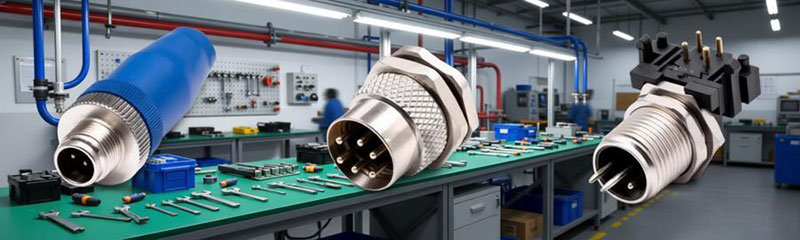
The M12 connector is a circular industrial connector with a metric threaded interface, widely used for signal, data, or power connections in automated environments. It is typically characterized by its compact design and threaded locking mechanism, which provide a stable and reliable electrical connection even under vibration or harsh operating conditions. Thanks to their industrial-grade reliability and standardized interfaces, M12 connectors are commonly found in sensors, actuators, and industrial communication systems, where they can be used for both basic signal transmission and applications such as high-speed industrial Ethernet.
| Term | M12 connector |
| Product category | Circular industrial connector |
| Typical functions | Signal, data, power |
| Key sourcing fields | MPN, coding, pin count, mounting type, datasheet |
| Buying reminder | Confirm exact specifications before RFQ |
● What "M12" Means?
"M12" refers to the mechanical interface specifications of a connector. Here, "M" stands for metric thread, and "12" indicates that the diameter of the threaded interface is approximately 12 mm. It is important to note that this designation defines only the physical dimensions and locking mechanism; it does not directly determine electrical performance. In practical applications, different coding types (such as A-code, D-code, and X-code) correspond to different signals or communication purposes.
● M12 Connector Common Uses in Industrial Automation
In the field of industrial automation, M12 connectors are widely used in various equipment interconnection scenarios, such as proximity sensors, photoelectric sensors, actuators, control cabinets, and industrial networks (e.g., PROFINET, EtherCAT) and fieldbus systems. Their standardized interfaces make it easier to connect devices from different manufacturers.
Their widespread adoption stems primarily from several engineering advantages. First, the threaded locking mechanism provides excellent vibration resistance, making it suitable for equipment environments involving mechanical motion; second, their compact size facilitates deployment in space-constrained equipment; furthermore, most M12 connectors feature high protection ratings (such as IP67/IP68), enabling them to operate reliably in dusty or humid environments. At the same time, their mature ecosystem reduces system integration complexity.
From a procurement perspective, "M12 connectors" do not refer to a single product model but rather a product category. When selecting a specific model, several key parameters must be clarified, including the coding type, pin count (e.g., 3, 4, 5, 8, or 12), gender (male/female), mounting method (panel-mounted or cable-mounted), termination method (soldering, crimping, or IDC), and whether shielding is required (especially in high-speed communication scenarios).
Once the exact specifications have been determined, we recommend purchasing based on the exact MPN or datasheet. Users can search for products by part number, view technical documentation, check current stock levels, or submit a quote request through UnikeyIC to streamline the product selection and procurement process.
Identify M12 Connector Types Before Sourcing
Before sourcing M12 connectors, one key point must be clear: M12 is not a single specification, but a connector family defined by multiple parameters. In many cases, "M12 interface" or "number of pins" alone is not enough to make the correct choice. In practice, coding, pin count, gender, mounting, termination, and shielding all determine whether the connector matches the target device.
If these key dimensions are ignored, the result may be mismating, electrical incompatibility, or even installation failure in the field. The standard workflow should be: identify the type first, review the datasheet next, and then move on to stock check or RFQ.
● Coding: A, B, D, X, L, S, K, T
Among all identification factors, coding is the most important first step. It is essentially a mechanical keying mechanism that prevents connectors from being incorrectly mated while also defining the electrical application.
Common M12 coding types can be grouped by application:
- Signal and general-purpose applications: A-coded and B-coded are commonly used for sensors, actuators, and basic control signals, and are among the most common variants.
- Industrial data and communication: D-coded and X-coded are mainly used in industrial Ethernet and other data communication applications that require better transmission performance.
- Power applications: L-coded, S-coded, K-coded, and T-coded are used for power transmission scenarios and usually support higher current or power requirements.
It is important to note that different coding types are physically incompatible, even if they look similar. Connectors with different coding should not be treated as interchangeable. In actual selection, buyers must refer to the device interface definition or the mating interface details in the datasheet rather than relying on experience.
● Pin Count, Gender, and Shielding
Once coding has been determined, additional electrical and mechanical matching details must be checked.
First is pin count. Common configurations include 3, 4, 5, 6, 8, 12, and 17 pins. Pin count determines how many signals or functions can be carried, and even connectors with the same coding may not be directly compatible if the pin count differs.
Second is gender, defined as male or female. This is one of the most basic but also most commonly overlooked matching requirements, and it must correspond exactly to the mating side.
Third is shielding. In high-speed data transmission or industrial environments with strong EMI, a shielded version is usually required to maintain signal integrity. For simple signal applications, an unshielded version may be used to reduce cost.
These parameters jointly determine the connector's electrical performance and connection reliability, and they should be verified in the datasheet one by one.
● Mounting and Termination Styles
In addition to electrical specifications, mounting and termination styles also have a direct impact on actual application.
Common mounting types include:
- Cable mount
- Panel mount
- PCB mount
Different mounting styles correspond to different system structures. For example, sensors often use cable-end or pre-molded connectors, while control cabinets or internal equipment may use panel-mount or PCB-mount connectors.
Common termination methods include:
- Solder cup
- Screw terminal
- Crimp
- PCB straight or right-angle
- Pre-molded cable assembly
These options affect assembly efficiency, maintenance convenience, and long-term reliability, so they should be selected according to production process and operating environment.
In addition, M12-related products include not only the connectors themselves, but also cable assemblies, T-splitters, junction boxes, and various accessories, all of which are system components that should be considered during the selection process.
Pre-selection and sourcing tip
Before checking stock or submitting an RFQ, it is best to confirm the full set of required parameters: coding, pin count, gender, mounting type, termination, and shielding. These details usually come from the device interface definition or the product datasheet.
With these parameters defined, buyers can use UnikeyIC to filter products more efficiently, compare specs, review datasheets, browse related M12 connectors or cable assemblies, and confirm availability before requesting a quote.
How to Choose the Right M12 Connector?
In real applications, choosing the right M12 connector is essentially a process of narrowing from application requirements to a specific part number, rather than choosing based on appearance or interface name alone. A typical selection workflow includes identifying the application, confirming electrical requirements, matching coding and pin count, verifying mechanical and environmental conditions, and finally confirming everything through the datasheet and MPN.
● Match Signal, Data, or Power Requirements
The first step is to identify the application. M12 connectors are widely used in sensors, actuators, industrial Ethernet, fieldbus systems, power distribution, and panel connections. Different applications create different electrical requirements.
Next, confirm the key electrical specifications, including voltage rating, current rating, signal type, and whether high-speed data transmission is required. These factors directly determine the basic connector type.
Then match the coding and pin count. Coding defines the application direction, such as signal, data, or power, while pin count must match the actual signal or function definition. Coding is not a casual choice; it is determined by system design. Likewise, a mismatch in pin count can lead to missing functionality or failure to connect.
● Check Mechanical and Environmental Fit
After electrical matching, it is essential to ensure that the connector can operate reliably in terms of mechanical design and the operating environment.
First is mechanical matching, which includes male/female connectors, mounting methods (cable-mounted, panel-mounted, or PCB-mounted), cable exit direction (straight or angled), and panel cutout dimensions. For pre-assembled cable assemblies, it is also necessary to verify that the cable length meets the actual installation requirements.
Next is the termination method, such as soldering, crimping, screw terminals, or molded-in cables. This will influence production assembly methods and future maintenance strategies.
Environmental adaptation is equally critical. Based on the application environment, it is necessary to confirm the IP protection rating (e.g., IP67/IP68), operating temperature range, housing material, and cable jacket performance (e.g., oil resistance, bend resistance). In scenarios involving electromagnetic interference or high-speed communication requirements, shielded designs should be prioritized to ensure signal integrity.
These factors collectively determine the long-term reliability of the connector under actual operating conditions—not merely whether it “works.”
● Confirm the Exact MPN and Datasheet
After narrowing down the options, the final decision must be confirmed using the datasheet and exact MPN.
Key items to verify include pin assignment, mating interface, dimensions, electrical ratings, and compliance notes such as RoHS. Mechanical drawings are also important because they often contain critical fit details.
When confirming the MPN, also check the manufacturer, full part number, and suffix variations. At the procurement stage, quantity, stock availability, MOQ/SPQ, lead time, and whether alternative parts are acceptable should also be considered.
Once the specifications are confirmed, buyers can search by MPN on UnikeyIC, view datasheets, compare specs, check inventory, or submit an RFQ. BOM uploads can also support multi-line sourcing and improve procurement efficiency.
What information should be confirmed before requesting an M12 connector quote?
Before submitting an RFQ, it is recommended to confirm the following key specifications to ensure the correct selection and improve sourcing efficiency:
- Target MPN or series: Identify the exact part number or manufacturer series.
- Coding type: A / B / D / X / L / S / K / T.
- Pin count: Common options include 3, 4, 5, 8, 12, or 17 pins.
- Gender: Male or female.
- Mounting type: Cable mount, panel mount, or PCB mount.
- Termination type: Solder, crimp, screw terminal, PCB, or pre-molded cable.
- Shielding: Shielded or unshielded, depending on EMI and data requirements.
- Orientation: Straight or right-angle.
- IP rating: For example, IP67 or IP68.
- Operating temperature range: Confirm based on the application environment.
- Electrical requirements: Voltage, current, and signal or data type.
- Cable length: Specify the length if using a cable assembly.
- Compliance requirements: Such as RoHS or REACH.
- Quantity: Estimated order volume.
- MOQ / SPQ sensitivity: Whether minimum order or standard packaging requirements apply.
- Alternative parts accepted: Yes or no.
Tip: All parameters should be verified against the datasheet. Confirming these details before requesting a quote can help avoid selection errors and save sourcing time.
Harsh Environment Checks for M12 Connectors
M12 connectors are widely used in harsh environments because of their sealed design, compact construction, and reliable mechanical locking. Compared with many standard connectors, the threaded locking mechanism helps maintain stable electrical contact under vibration, dust, moisture, and other demanding conditions.
Why are M12 connectors preferred in harsh environments?
M12 connectors are commonly used in dusty, splash-prone, and vibrating environments, as well as on factory floors, outdoors, and in industrial settings, because buyers typically require sealed, compact, and mechanically robust interconnection solutions. Their threaded locking design effectively resists loosening caused by vibration, and the sealed construction prevents dust, sand, and water from entering the connector. In addition, the standardized M12 interface supports multiple coding types, making it easy to select the appropriate signal, data, or power solution for different applications.
Typical application scenarios include:
- Sensors and actuators (proximity sensors, photoelectric sensors)
- Industrial Ethernet (PROFINET, EtherCAT)
- Fieldbus systems
- Outdoor equipment and washdown environments
- High-vibration machinery
● IP Rating, Sealing, and Locking Style
IP rating is the first item to check when selecting a connector for harsh environments. It indicates resistance to dust and water. Common ratings include IP67, IP68, and IP69K, but not every M12 connector has these ratings. The actual rating depends on the specific part number and the datasheet.
Key Notes on IP Ratings
| IP RatingProtective CapabilityTypical Use Cases | ||
| IP67 | Dust-proof + Short-term submersion | Inside factories, general industrial environments |
| IP68 | Dust-proof + Continuous Submersion | Underwater equipment, humid environments |
| IP69K | Dust-proof + high-temperature, high-pressure washdown | Washdown, food processing, high-humidity outdoor environments |
Important notes:
- Do not assume all M12 connectors are waterproof.
- IP67, IP68, and IP69K are not default capabilities; always verify the datasheet.
- Different models may correspond to different IP ratings.
Sealing is usually provided by rubber gaskets or polymer seals to prevent dust, water, oil, and washdown fluids from entering the interface. The required level of sealing depends on the exposure type.
- Dust environments: prioritize stronger dust protection.
- Water splash or immersion: confirm IP67 or above.
- Washdown or chemical exposure: choose materials that resist oil and chemicals.
Locking style is generally divided into two categories:
- Threaded locking: strong vibration resistance, suitable for high-vibration industrial environments.
- Push-pull locking: faster installation, but weaker vibration resistance.
Selection guidance:
- High vibration or moving equipment: threaded locking.
- Low vibration or frequent mating: push-pull locking, provided the mating cycle is confirmed.
● Temperature, Materials, and Compliance Checks
Operating temperature directly affects material performance and electrical reliability. Common M12 operating ranges are -25°C to +85°C, and some parts extend to -40°C to +105°C. Always confirm the temperature range based on the actual application to avoid material aging or contact failure under extreme conditions.
Material and plating considerations include:
- Housing material: plastic for light weight and corrosion resistance, or metal such as stainless steel or brass for higher mechanical strength.
- Contact material and plating: copper alloy and gold plating can affect conductivity and corrosion resistance.
Different materials are better suited for different environments:
- Chemical exposure: prefer corrosion-resistant metal housings.
- Outdoor use: consider UV-resistant materials.
- High vibration: metal housings are generally more robust.
Cable jacket material is also important:
- PVC: general-purpose and low cost.
- PUR: oil-resistant and flexible, suitable for industrial use.
- Other specialty materials: for chemical resistance or UV resistance.
Compliance may also be required in some projects, including:
- RoHS
- REACH
- Other industry certifications for automotive, medical, or export applications
For RFQs, include the required IP rating, operating temperature, material preference, and compliance needs. Buyers can also contact sales to confirm product availability and documentation support.
Harsh-Environment Verification List
Before submitting a request for quotation, we recommend that you thoroughly verify the following environmental compatibility parameters:
| Check ItemWhat to ConfirmWhy It Matters | ||
| Required IP rating | IP67 / IP68 / IP69K | Dust and water protection |
| Temperature range | -25°C to +85°C or wider | Material performance and electrical reliability |
| Exposure type | Dust / water / oil / chemicals / washdown / outdoor | Determines sealing and material choice |
| Vibration or movement | High vibration / low vibration | Affects locking style selection |
| Shielding requirement | Shielded / unshielded | EMI and signal integrity |
| Cable jacket requirement | PVC / PUR / other | Oil resistance, flexibility, chemical resistance |
| Mating cycle or maintenance | Frequent mating / permanent install | Affects material life and contact design |
| Datasheet and compliance check | RoHS / REACH / other | Regulatory and project requirements |
Procurement tip
Before placing an order, confirm the exact specifications against the datasheet. In your RFQ, include:
- Required IP rating
- Operating temperature
- Material preference
- Compliance needs
On UnikeyIC, you can view product details, check availability, and request compliance documentation through sales.
Important Reminder:
- Do not assume that all models are suitable for outdoor, washdown, chemical exposure, or high-vibration environments.
- UnikeyIC does not guarantee that all models meet specific IP ratings or environmental requirements; please refer to the datasheet and manufacturer's instructions for details.
- If you are unsure, we recommend contacting the FAE team for one-on-one product selection support.
Key takeaway:
The reliability of M12 connectors in harsh environments typically depends on three main dimensions: IP rating and sealing, locking style, and temperature/material/compliance factors.
When selecting a connector, be sure to refer to the datasheet and avoid relying on experience alone. Once you have confirmed the specifications, you can use UnikeyIC to quickly check inventory, compare parameters, and submit a quote request.
Sourcing M12 Connectors: Datasheet, Stock, RFQ, and BOM
Once you understand the M12 connector types and selection logic, the next step is actual sourcing. Unlike many standard components, "M12 connector" is a broad category term, and searching only by "M12" or "M12 connector" often makes it difficult to match the exact part number required for your project.
When sourcing, buyers should prioritize:
- Manufacturer Part Number (MPN)
- Manufacturer / brand
- Series
- Datasheet, including revision
- BOM line item
Keywords are useful for initial browsing and comparison, but MPN and datasheet are the real basis for confirmation and ordering.
● Search by MPN, Not Only by Keyword
Many buyers start by searching "M12 connector," but the results are usually too broad and may include:
- Different coding types
- Different pin counts
- Different mounting styles
- Different termination styles
- Different protection ratings
Even when they look similar, different M12 part numbers can differ greatly in electrical performance and mechanical fit.
Why Should MPN Be Given Priority in Procurement?
- It identifies a specific, exact part.
- It links directly to the datasheet, revision, and any specification updates.
- It is the key field in a BOM for procurement and replacement review.
If you do not have an MPN, at minimum provide:
- Manufacturer / brand
- Series
- Coding and pin count
- Mounting type and termination type
- Datasheet or interface drawing
After completing the initial identification, use the MPN to conduct a precise search and confirmation.
● Check Availability, Price Breaks, MOQ, SPQ, and Lead Time
Once the target model has been confirmed, the procurement decision must move beyond simply checking "availability" to determining "whether it fits the project timeline."
1. Inventory and Lead Time
Key points to verify include:
- Stock availability: Whether the item is in stock or needs to be shipped from the factory;
- Lead time: How long the lead time is and whether it meets the project's go-live date;
- Packaging or supply format: bulk, on a reel, in a box, on a pallet, etc., which affects production and assembly methods.
Stock availability and lead times for M12 connectors can vary significantly depending on the model and brand. Some standard models may be in stock long-term, while special part numbers or custom cable assemblies may require longer lead times.
2. Pricing and Procurement Thresholds
When procuring, you should also pay attention to:
- Unit price: Base unit price;
- Volume pricing: Tiered pricing based on quantity;
- MOQ (Minimum Order Quantity): Minimum order quantity;
- SPQ (Standard Packaging Quantity): Standard packaging quantity.
For example, a particular model might have:
- MOQ = 100 pcs
- SPQ = 50 pcs/box
- Different unit prices for orders of 100 pcs and 500 pcs
Whether or not you accept the MOQ and SPQ will directly impact costs and procurement strategies, especially for repair, replacement, or small-batch projects.
3. Compliance and Documentation
If the project has compliance requirements, the following must also be confirmed:
- RoHS: Restriction of Hazardous Substances;
- REACH: Registration, Evaluation, Authorization, and Restriction of Chemicals;
- Datasheet revision: Whether the specification version is up to date;
- Drawing / 3D PDF: Whether mechanical drawings or 3D models are required for assembly design.
Clearly specifying these requirements in the RFQ can prevent subsequent shipment delays or project setbacks caused by compliance issues.
● Compare Alternatives Carefully
In project procurement, alternative parts are a common requirement, but substitution is not based solely on appearance or interface type.
Key items to check when comparing alternatives:
| Check ItemWhat to ConfirmWhy It Matters | ||
| Coding | A / B / D / X / L / S / K / T | Prevents mismating and defines application |
| Pin count | 3 / 4 / 5 / 8 / 12 / 17 | Determines signal count |
| Mounting type | Cable / panel / PCB | Affects installation style |
| Termination type | Solder / crimp / screw / PCB | Affects assembly and reliability |
| Shielding requirement | Shielded / unshielded | Affects EMI and signal integrity |
| Compliance requirement | RoHS / REACH / other | Regulatory and project requirements |
| Datasheet | Pin assignment, interface dimensions, electrical ratings | Determines whether replacement is truly compatible |
Important reminders:
- Different brands may not be pin-to-pin compatible, even if they are all M12.
- Whether a substitute works must be verified using the datasheet, pin definition, and actual interface dimensions.
- Mechanical fit, pin assignment, and environmental ratings are often more important than appearance.
When evaluating replacements, it is recommended to compare the datasheets of the original and replacement models side by side, paying particular attention to:
- Pin assignment
- Mating interface dimensions
- IP rating and temperature range
RFQ Information Module
To speed up RFQ response, submit the following structured information. You can copy this checklist directly for internal use or send it to suppliers.
| FieldInformation to Provide | |
| Target MPN | Exact part number, e.g. UNI-M12-XXXX |
| Manufacturer / brand | Manufacturer / brand |
| Required coding and pin count | e.g. D-coded, 5-pin |
| Mounting type | Cable / panel / PCB |
| Termination type | Solder / crimp / screw / PCB |
| Shielding requirement | Shielded / unshielded |
| Quantity | Order quantity |
| Target delivery window | e.g. before 2026-09-30 |
| Compliance requirement | e.g. RoHS, REACH |
| Datasheet or drawing requirement | Datasheet / drawing / 3D PDF needed or not |
| Whether alternatives are acceptable | Yes / No |
| Notes for replacement, repair, or BOM sourcing | Replacement / repair / BOM sourcing notes |
On UnikeyIC, you can:
- Check stock status
- View datasheets
- Submit RFQs for quotes
- Upload BOMs for consolidated sourcing
- Compare alternative parts
- Contact sales to confirm availability and documentation support
Where Can I Find M12 Connectors?
If you need to find M12 connectors, you can:
- Search by exact MPN
- Verify the datasheet and confirm coding, pin count, mounting, and termination
- Check stock and lead time on a distribution platform such as UnikeyIC
- Submit an RFQ or BOM to get pricing and sourcing support
- Compare alternative parts and confirm compatibility with sales
M12 connectors can be sourced efficiently through MPN search, datasheet verification, inventory and lead time checks, and RFQ or BOM submission on a distribution platform such as UnikeyIC.
Sourcing takeaway:
In M12 connector procurement, the three core priorities are search method, purchasing decision criteria, and replacement evaluation. After confirming the part, search by MPN, review the datasheet, compare alternatives, and submit an RFQ or BOM to get faster sourcing support.
FAQ for M12 Connector Buyers
This FAQ is designed as a quick reference for M12 connector buyers, focusing on pre-purchase decision points, datasheet checks, and RFQ/BOM preparation. The answers are intentionally concise so buyers can quickly find the information they need.
● Quick Buyer Questions
Q1: What is an M12 connector?
An M12 connector is a circular industrial connector with a metric threaded interface. It is commonly used for signal, data, or power connections in automation environments. The "M12" usually refers to an interface diameter of about 12 mm, and it is widely used in sensors, actuators, industrial Ethernet, and fieldbus systems. Selection should confirm coding, pin count, mounting, and IP rating.
Q2: What are the main types of M12 connectors available?
M12 connectors are divided by coding into A, B, D, X, L, S, K, and T types, which correspond to signal, data, or power applications. They are also classified by pin count, gender, mounting style, and termination style. Different combinations create different part numbers, so procurement should always be based on the exact MPN.
Q3: How do I choose the right M12 connector for my application?
To choose the right M12 connector, confirm the application type, coding and pin count, mounting and termination style, IP rating, operating temperature, shielding requirement, and compliance needs such as RoHS or REACH. The final decision should be verified against the datasheet and exact MPN before submitting an RFQ or BOM.
Q4: Why are M12 connectors preferred in harsh environments?
M12 connectors are commonly used in dusty, wet, and vibration-prone industrial environments because their sealed design, compact size, and threaded locking mechanism help maintain reliable connections. Different parts have different IP ratings such as IP67 or IP68, but not all M12 connectors are waterproof, so the datasheet must be checked.
Q5: Where can I find M12 connectors?
You can search by MPN, verify the datasheet, and use a distribution platform such as UnikeyIC to check current stock, view datasheets, request a quote, or submit your BOM. If alternatives are needed, compare alternative parts and confirm availability and documentation with sales.
Q6: Do I need an MPN to buy an M12 connector?
For formal sourcing, it is best to provide the MPN. If you do not have one, you should at least provide the manufacturer, coding, pin count, mounting type, termination type, and a datasheet or interface drawing. "M12 connector" alone is not enough for accurate sourcing.
Q7: What should I check when replacing an M12 connector with an alternative?
Do not rely on appearance alone. Check the coding, pin count, mounting type, termination type, shielding requirement, and compliance requirement. Different brands may not be pin-to-pin compatible. A substitute should always be verified against the datasheet and the actual interface definition.
Q8: What information should be included in an RFQ for an M12 connector?
An RFQ should include the target MPN, manufacturer, coding, pin count, mounting type, termination type, shielding requirement, quantity, target delivery window, compliance requirement, whether a datasheet or drawing is needed, and whether alternatives are acceptable. This helps suppliers match and quote the part more quickly.